Controlling marks in Tim Massey’s Work

I had the pleasure of helping hang Tim Massey’s current exhibition of illustrations at the University of Rochester’s Art and Music Library gallery. This allowed me to look closely and study his mark making techniques that are full of delightful details.

As a lover of nature and a dog lover, his illustrations of plant life and dogs showed his emotional and personal interest in these forms. These are “two prime examples of what “we as humans have tried to control trough domestication, breeding, grafting, etc,” Massey says in his artist’s statement. His work is about this control, or lack of control.

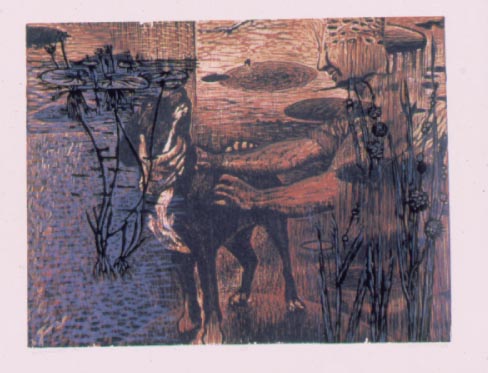
Especially apparent in his illustration containing dogs, is is realization that animals have animal instincts even though they may be completely loyal to us. The tenuous balance between wildness and domesticity can be seen in his illustrations.

His illustration titled “reassured” I found on his website is a good example of this tenuous balance. The man’s calming hand reaches out to the dog to ‘reassure’ him.
"Reassured" by Tim Massey

Tim is another artist who’s use of layering of marks and images is inspirational to me. His techniques is masterful as he overlaps values and tones of imagery. I simply loved exploring his beautiful illustrations and aesthetic!

If you have the opportunity to see his work at the Art & Music library you will be sure to enjoy it too! Tim is currently Assistant Professor of Art and Gallery Director at SUNY College
at Brockport, Brockport, New York. Some other examples of his work can be seen at:

www2.pittstate.edu/art/harrykruggal/TMassey/


The Layers of Jane Notides-Benzing

Jane Notides-Benzing is one of the award winners in this year’s Arts & Cultural Council’s juried 2011 “Summer Member Exhibition”. Her mixed-media, three dimensional work “High Tension Storm” was selected for an Award of Excellence. It is one of three pieces in the show, including “Fiesta Sky” and “Memory Rain”, that show her multi-layered work encased in Plexiglass.

"Memory of Rain" by Jane Notides-Benzing

In an article about her work in the Art & Cultural Council’s Fall 2011 publication Metropolitan (page 21) she describes what inspired this current work.

“A few years ago, at the Museum of Modern Art in New York city, I saw two giant sheets of transparent fabric suspended from the ceiling. As I walked through the gallery, I was intrigued by the way I could see through the first sheet and blend the two images together.”

The plexiglass case that encloses each of her abstract multi-layered works could be thought of “as a miniature gallery,” she says.

Creating a miniature gallery with the transparent box works well to focus our gaze on her artwork. I like her layering technique using transparent materials with abstract markings. She is “interested in vaporous and watery elements with intrinsic energy: clouds, rain, sunshine,” Norides-Benzing says.

The show at the Arts & cultural Council’s space is open through November 30th, with a reception November 30th from 5 – 7 pm. If you are in the area stop by and look at her work, or go to their website:
http://www.artsrochester.org/

The Inflated Works of Benjamin Entner

One of the greatest benefits of a course at Visual Studies Workshop in Museum and Gallery Management was the behind the scenes tour of the set-up for the Memorial Art Gallery’s 2001 Finger Lakes exhibit. The pros and cons of installing a gallery show were explained as we walked through the show’s gallery space.

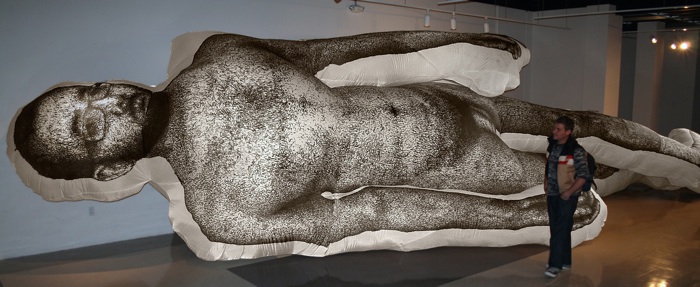
As we turned a corner in the exhibit space, Benjamin Entner’s giant, inflated nude male figure titles “Self Portrait on a Cold Day” was a delightful artistic discovery. His piece really intrigued me since I have spent many years creating my own 3-dimensional stuffed pieces I’ve painted and drawn on — similar to Entner’s technique.

Benjamin Entner's "Self Portrait on a Cold Day"

He draws on his fabric with Sharpie marker, making shadows and highlights with the lines. Entner creates tension in the fabric by inflating it, and at the same time his hard black lines on the soft fabric create a different type of tension.

He experiments with materials and plays conceptually as he creates his work. The viewer interacts and reacts with his work through the use of large physical presence, wonder and humor.

His artist’s statement says he “explores the boundaries and interplay between two and three dimensional methods of making. Specifically, the point at which a drawing can become form and an object can become representation.”

“Self Portrait on a Cold Day” certainly is a drawing that has become a form, as well as bringing humor and wonder into my experience.

More of his fun artwork can be seen on his website:
http://www.benjaminentner.com/

My Art Investigates Memory

“I remember being terrified as my Grandfather’s goose nipped at my heals while I frantically tried to run up the steep flight of stairs. I returned 30 years later to discover those stairs were only three steps.”

I’ve always been fascinated the memories people have of their life’s experiences. And I’ve been especially interested in childhood memories. In my work I explore and transform personal memory and the past. Through my own memories and memories of others, my histories and my photographic archives, I try to represent that past.

Memories often reveal themselves in layers. I overlap fabric, images and paint to reflect his layering. Sometimes my paint and stains are blurred like the edges of memory. We seldom remember with sharp and exact detail, in the same way the edges of my work are not always sharp and exact.

Layers overlap as memories overlap. I often use fabric removed from the traditional stretchers to explain a certain narrative through the layering of fabric, paint and other embellishments. The lines and shapes are often in fragments, as are bits of our memory.

Images of family memories are easy to relate to, while not revealing specific histories. I use objects and figures to trigger memories of times, situations and emotions of the past.